Why Manufacturer Selection Matters More Than Price
10 Questions to Ask a Ring and Pinion Gear Manufacturer
These questions are designed to cut through marketing language and get to what actually matters: process control, material integrity, and supplier reliability. Use them in your first conversation with any new manufacturer — the quality of their answers will tell you as much as the answers themselves. A supplier who responds with confidence and detail is one who knows their operation. A supplier who hedges, deflects, or gives generic answers is showing you exactly how they will handle problems later.
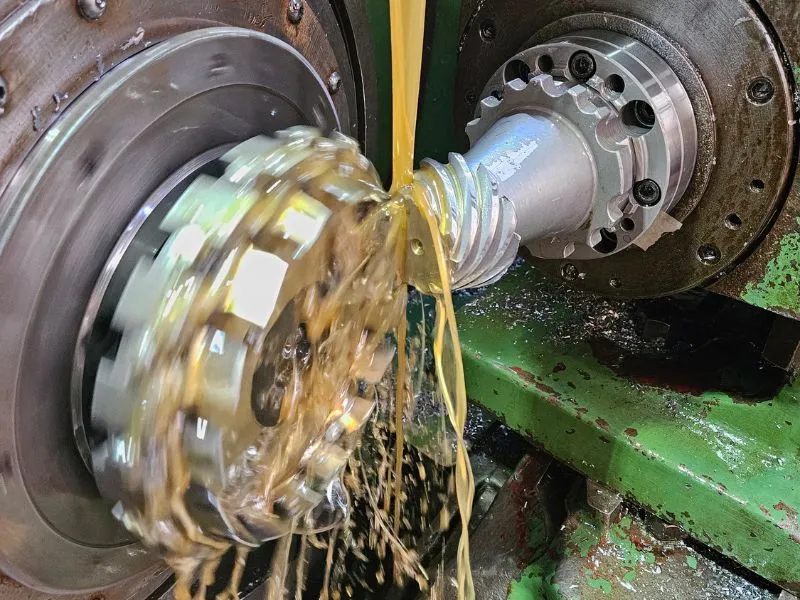
1. What Is Your Manufacturing Process for Ring and Pinion Gears?
Key follow-up: Do they perform the entire process in-house, or do they outsource heat treatment or grinding to third parties? In-house control generally means tighter quality consistency.
2. What Steel Grades Do You Use?
| Steel Grade | Key Composition | Core Properties | Best For |
|---|---|---|---|
|
20CrMnTi |
Cr, Mn, Ti alloyed |
Excellent case hardenability, good toughness, high surface hardness after carburizing |
Standard automotive and commercial vehicle applications; widely used in OEM production |
|
8620 |
Ni-Cr-Mo alloyed |
Reliable hardenability, good core toughness, cost-effective |
Passenger vehicles, light trucks, aftermarket replacement gears |
|
9310 |
High Ni-Cr-Mo alloyed |
Superior core strength and impact toughness, deep case hardenability |
Heavy-duty, high-performance, racing, and military-spec applications |
Be cautious of suppliers who cannot specify their material grade, or who offer vague answers like “high-quality alloy steel.” Ask for material certificates — any credible manufacturer should be able to provide mill certificates (also called material test reports) confirming the chemical composition and mechanical properties of the steel used.
3. What Quality Control Processes Do You Have In Place?
Ask about:
- Incoming material inspection: Is steel tested before production begins?
- In-process inspection: Are gear tooth profiles checked during cutting?
- Post-heat treatment inspection: Is hardness measured after heat treatment on every batch?
- Final dimensional inspection: Are key dimensions — tooth pitch, backlash tolerance, runout — verified before shipment?
- Gear testing equipment: Do they use a CMM (Coordinate Measuring Machine) or gear measuring center? Manufacturers with dedicated gear metrology equipment take precision seriously.
4. Can You Provide Custom Ring and Pinion Gears?
Ask specifically:
- Can you produce non-standard gear ratios?
- What is your minimum order quantity (MOQ) for custom specifications?
- Do you require tooling fees for custom gear profiles?
- What is the lead time for custom orders versus standard catalog items?
For a detailed walkthrough of the custom sourcing process, see: How to Source Custom Ring and Pinion Gears: A Guide for Distributors and OEM Buyers
5. What Applications and Vehicle Models Do You Cover?
Look for manufacturers with coverage across:
- Passenger vehicles (sedans, SUVs, pickups)
- Light commercial vehicles (vans, light trucks)
- Heavy commercial vehicles (medium and heavy-duty trucks)
- Off-road and 4WD applications (Jeep, Land Rover, Toyota Land Cruiser, Ford Bronco)
- Agricultural and industrial machinery
6. What Are Your Lead Times and Production Capacity?
Ask about:
- Standard catalog item lead time: What is the typical ship time for items in stock?
- Made-to-order lead time: For items produced on demand, what is the production cycle?
- Surge capacity: Can they handle large or urgent orders? What is their monthly production volume?
- Safety stock policy: Do they maintain buffer inventory for high-demand SKUs?
Also ask how they communicate proactively when delays occur. A manufacturer who surfaces problems early gives you time to manage your customers. One who goes silent until a deadline is missed is a liability.
7. Do You Offer OEM-Level Documentation and Traceability?
Ask whether the manufacturer can provide:
- Batch traceability records
- Material test reports (MTRs)
- Heat treatment logs
- Dimensional inspection reports per shipment
Some manufacturers laser-etch batch codes directly onto gear blanks, enabling full field traceability. This level of documentation is standard in aerospace and military supply chains, and increasingly expected in premium automotive aftermarket procurement.
8. What Is Your Minimum Order Quantity and Pricing Structure?
Understand the full pricing structure:
- Unit price at your target volume: Get quotes at multiple quantity tiers to understand the price curve.
- Tooling charges: For custom gears, are tooling costs amortized across an order, or charged upfront?
- Packaging and labeling options: Can they pack under your brand (white label / OEM packaging)?
- Payment terms: T/T (Telegraphic Transfer) is the most common method in the auto parts industry — typically 30% deposit upfront with the balance paid before shipment or against the bill of lading. Some suppliers also accept PayPal for smaller orders or samples. Confirm the payment structure clearly before placing any order.
Don’t negotiate purely on unit price at this stage. A slightly higher unit price from a manufacturer with superior quality control, reliable lead times, and strong documentation can deliver significantly lower total cost of ownership over time.
9. Can You Provide References or Sample Orders?
Always request sample gears before committing to a volume order. Evaluate samples against:
- Dimensional accuracy: Measure tooth pitch, OD, bore dimensions against spec
- Surface finish: Look for consistent grinding marks; irregular patterns suggest process variation
- Hardness testing: A Rockwell hardness test on the tooth surface can confirm heat treatment quality
- Noise test: If you have test equipment, run the gear under load and check for abnormal noise
A manufacturer who resists sending samples, or who imposes unreasonably high sample costs, is worth treating with caution.
10. How Do You Handle Claims and After-Sales Support?
Ask about:
- Warranty policy: What is the warranty period, and what does it cover?
- Claim process: How do you initiate a claim? What documentation is required?
- Response time: How quickly do they acknowledge and resolve claims?
- Root cause analysis: Will they investigate and provide a written RCA for significant failures?
- Technical support: Do they have engineers available to assist with gear selection, fitment questions, or installation troubleshooting?
A manufacturer with a clear, documented claims process — and a track record of honoring it — is one you can build a long-term relationship with.
Red Flags to Watch For
Beyond the ten questions above, watch for these warning signs when evaluating any ring and pinion gear manufacturer:
- Unable to provide material certificates: Suggests either low-grade materials or lack of traceability infrastructure.
- No in-house inspection equipment: Relying solely on visual inspection is insufficient for precision gear components.
- Vague answers to technical questions: A manufacturer who cannot explain their own process is unlikely to control it well.
- Pricing that seems too low: Gear manufacturing is material- and process-intensive. Unrealistically low prices almost always reflect compromises in material grade, heat treatment, or inspection.
Building a Long-Term Supplier Relationship
Conduct periodic supplier audits (annually or bi-annually for critical suppliers), review quality metrics over time, and maintain open dialogue about your evolving product requirements.
Final Thoughts
If you’re currently evaluating sources for ring and pinion gears — whether standard fitments or custom ratios — XJX is a specialized ring and pinion gear manufacturer with over a decade of experience supplying distributors, workshops, and OEM buyers across more than 60 countries. We offer full material traceability, in-house gear grinding and heat treatment, and custom manufacturing capabilities with no minimum order requirement on standard catalog items. Feel free to contact our team to discuss your requirements or request a sample evaluation.