Hypoid vs. Spiral Bevel Ring and Pinion

In the world of power transmission and automotive engineering, the choice of gearing dictates not only the efficiency of a machine but also its durability, noise profile, and spatial configuration. When it comes to right-angle drives, two dominant designs lead the industry: the Spiral Bevel gear and the Hypoid gear. While they may appear similar to the untrained eye, the mechanical distinctions between these two types of ring and pinion sets are profound.
Understanding these differences is essential for engineers, fleet managers, and performance enthusiasts alike. Selecting the wrong gear type for a specific application can lead to premature failure, excessive heat generation, or intolerable noise levels. This article provides an in-depth technical analysis of Hypoid vs. Spiral Bevel ring and pinion sets, examining their geometry, performance characteristics, and practical applications.

The Fundamentals of Right-Angle Gearing

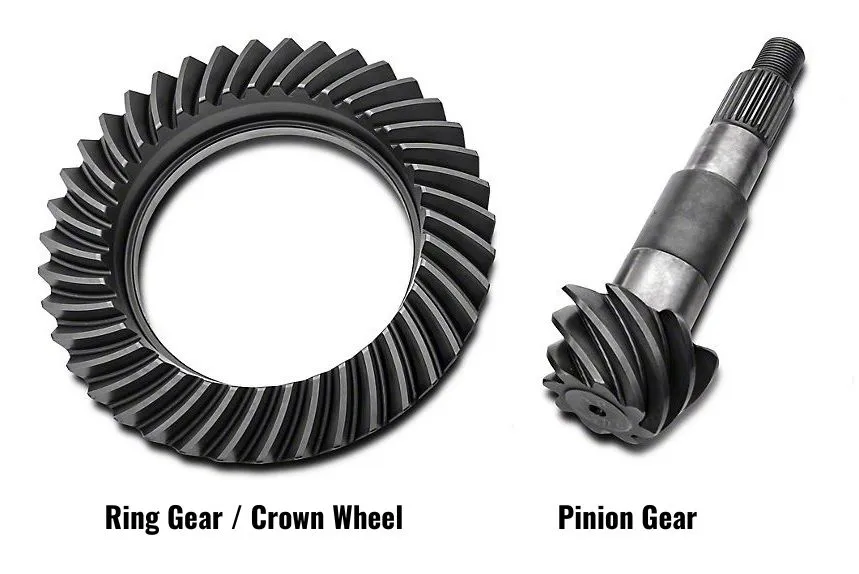
Before diving into the comparison, it is vital to establish a baseline of what these components do. At its core, a ring and pinion set is designed to transfer power from a longitudinal shaft (like a driveshaft) to a transverse shaft (like an axle). This 90-degree change in direction is accompanied by a gear reduction, which multiplies torque—the force that actually moves heavy loads or accelerates a vehicle.

To get a foundational grasp of the mechanics involved, you might find it helpful to review this guide on how ring and pinion gears work, which breaks down the basic terminology and interaction of these gear sets.

Geometry and Design: The Offset Difference

The primary differentiator between a Spiral Bevel and a Hypoid gear set is the relationship between the axes of the two gears.

Spiral Bevel Gears

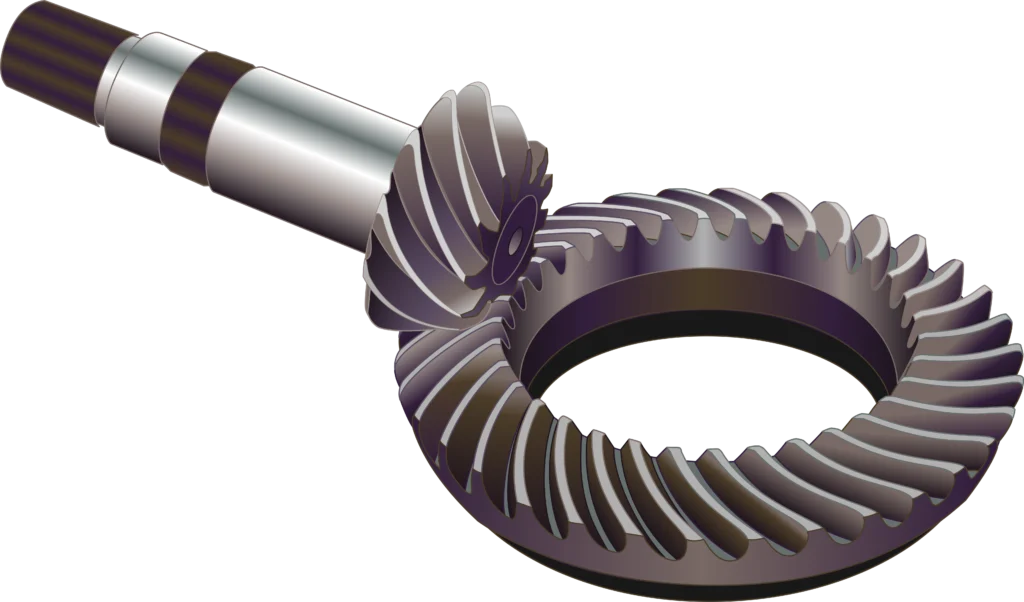
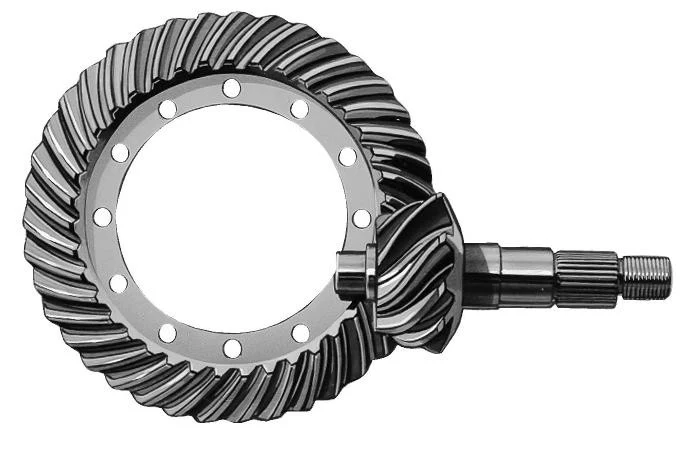
In a Spiral Bevel arrangement, the axes of the pinion and the ring gear intersect at a single point. The teeth are curved and oblique, allowing for a gradual engagement. Because the axes intersect, the pinion is positioned directly in the center of the ring gear’s diameter. This symmetry is ideal for high-speed applications where mechanical simplicity and balance are prioritized.
spiral bevel ring and pinion gears
Spiral Bevel ring and pinion gears
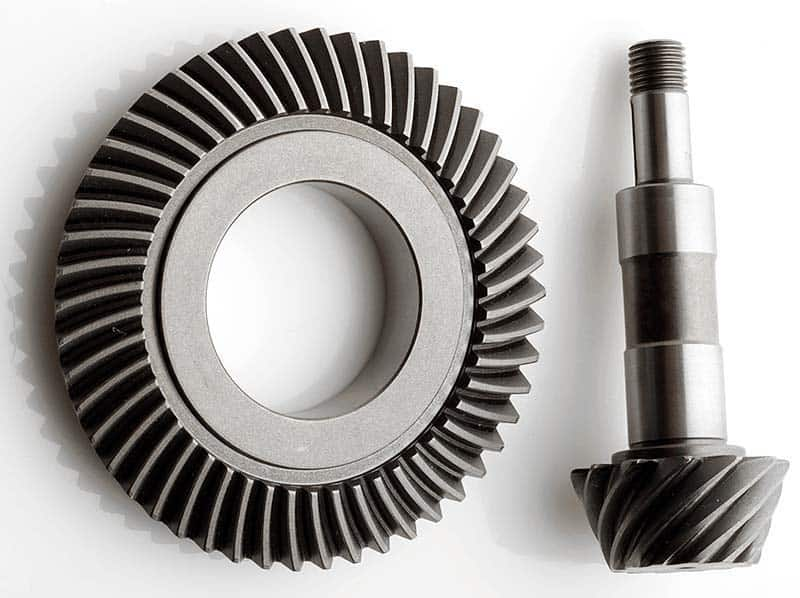
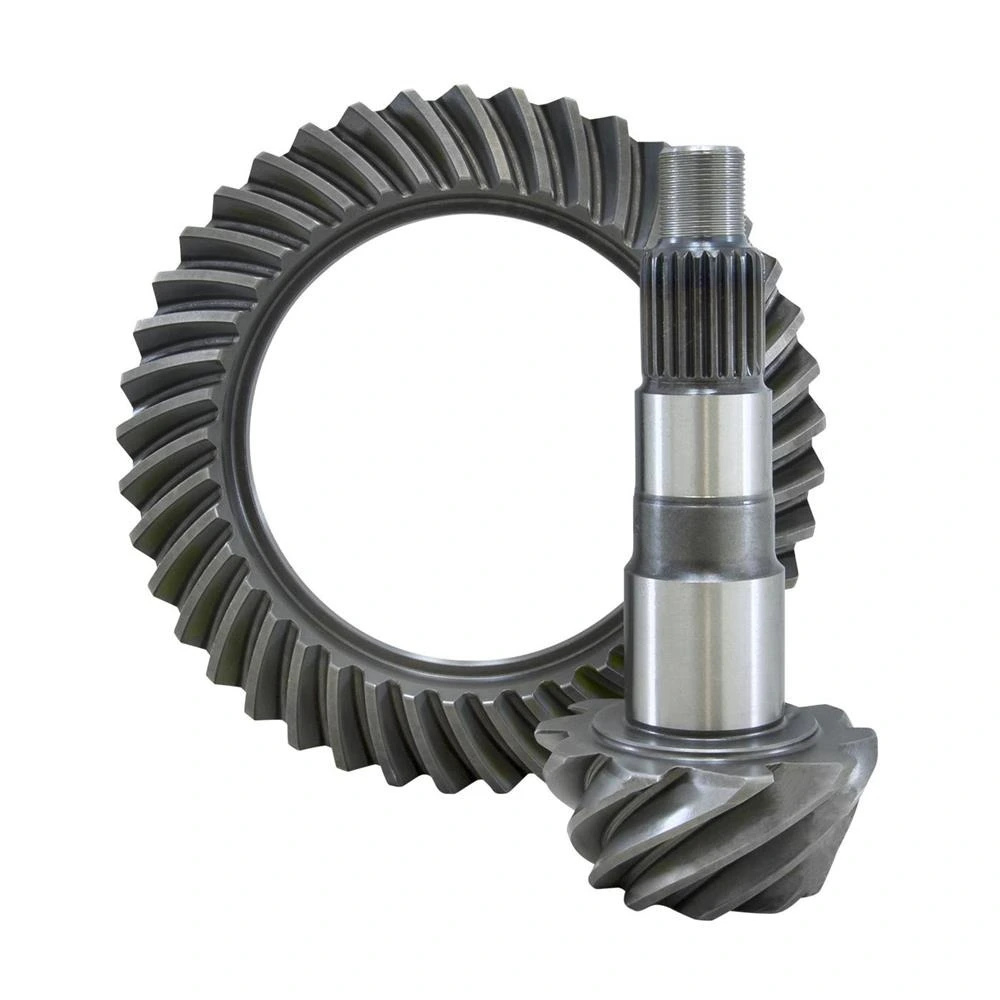
Hypoid ring and pinion Gears
Hypoid ring and pinion gears

Hypoid Gears

Hypoid gears are a specialized evolution of the spiral bevel design. The defining characteristic of a Hypoid set is that the axes do not intersect. Instead, the pinion is offset from the center of the ring gear—usually positioned lower than the centerline. This offset creates a hyperbolic pitch surface (hence the name “Hypoid”). This design tweak changes the entire physics of the gear engagement, introducing a significant amount of sliding action along with the rolling motion.

Mechanical Advantages of Hypoid Gear Sets

Hypoid gears have become the standard for most modern automotive rear-drive axles, and for several very specific reasons.

1. Increased Strength and Surface Contact

Because the pinion is offset, the diameter of a hypoid pinion is typically larger than that of a spiral bevel pinion with the same gear ratio. A larger pinion means more surface area on the teeth and a higher “contact ratio.” In engineering terms, having more teeth in contact simultaneously spreads the load, making the Hypoid set significantly stronger and more capable of handling high-torque loads without tooth breakage.

2. Lower Center of Gravity

In automotive applications, the downward offset of the pinion allows the driveshaft to be positioned lower. This translates to a shallower “hump” in the vehicle’s floorpan, allowing for more cabin space and, more importantly, a lower center of gravity for the vehicle. This improves handling and stability, especially in heavy-duty trucks and SUVs.

3. Superior Quietness and Smoothness

The sliding motion inherent in Hypoid gears results in a smoother engagement compared to the more abrupt rolling contact of straight bevel gears. When properly lapped and shimmed, a Hypoid ring and pinion set operates with minimal vibration, making it the preferred choice for luxury vehicles and high-end industrial machinery where NVH (Noise, Vibration, and Harshness) levels are a critical metric.

The Performance Trade-offs: Efficiency and Heat

While the Hypoid design offers strength and quietness, it comes with a physical “tax.” The sliding action that makes them quiet also generates friction.

Sliding Friction and Heat Generation

In a Spiral Bevel set, the motion is primarily rolling. In a Hypoid set, the teeth must slide across one another as they rotate. Friction produces heat. Consequently, Hypoid gears run hotter than Spiral Bevel gears. This is why Hypoid systems require specialized Extreme Pressure (EP) lubricants. These oils contain additives like sulfur and phosphorus that create a sacrificial coating on the gear teeth, preventing metal-to-metal welding under high heat and pressure.

Mechanical Efficiency

In terms of pure energy transfer, Spiral Bevel gears are slightly more efficient. A high-quality Spiral Bevel set can achieve 98-99% efficiency. A Hypoid set, due to sliding losses, typically falls between 90% and 96%. In industrial settings where a machine runs 24/7, that 3-5% difference in efficiency can lead to significant energy costs over time. However, in automotive contexts, the strength and packaging advantages of the Hypoid set usually outweigh the slight loss in efficiency.

Key Applications: When to Use Which?

Choosing between these two is rarely about which gear is “better” in an absolute sense, but rather which is “right” for the environment.

Where Spiral Bevel Gears Excel:

  • High-Speed, Low-Torque Scenarios: Applications where heat dissipation is a concern and the load is relatively constant.
  • Handheld Power Tools: The lack of offset allows for more compact, symmetrical tool housings (like in an angle grinder).
  • Aerospace Transmissions: Where every percentage of mechanical efficiency counts and weight must be minimized.
  • Racing Applications: Some specialized racing differentials prefer the lower friction of spiral bevels if the torque requirements allow for it.

Where Hypoid Gears Excel:

  • Automotive Differentials: From light cars to heavy-duty Class 8 trucks, the Hypoid is king due to its strength and cabin packaging benefits.
  • Heavy Construction Machinery: Bulldozers, excavators, and earthmovers require the massive torque multiplication that only a large-diameter hypoid pinion can reliably provide.
  • Industrial Worm-Gear Replacements: In some right-angle industrial drives, Hypoids are used as a more efficient alternative to worm gears while still offering high reduction ratios.

Maintenance and Installation Considerations

From a technician’s perspective, the installation of a ring and pinion set is a precise art. However, Hypoid gears are notoriously more sensitive to setup than Spiral Bevels.

Mounting Distance and Backlash

Setting the “depth” of the pinion is critical. Because of the offset, a slight error in the pinion position in a Hypoid set will drastically alter the contact pattern, leading to rapid wear and “howling” noises. Technicians must use gear marking compound to ensure the “sweep” of the contact is centered on the tooth.

Lubrication Requirements

You cannot use standard gear oil in a Hypoid system. As mentioned earlier, the sliding action requires GL-5 rated lubricants. Using a GL-4 or non-EP oil in a Hypoid differential will often result in catastrophic failure within a few hundred miles of operation. Spiral Bevel gears are much more forgiving in this regard, though they still benefit from high-quality lubrication.
Feature Spiral Bevel Hypoid
Axis Relationship
Intersecting
Non-intersecting (Offset)
Pinion Size
Smaller
Larger (Stronger)
Efficiency
Very High (98%+)
High (90-96%)
Noise Level
Moderate
Very Low / Quiet
Lubrication
Standard Gear Oil
Extreme Pressure (EP) Oil
Primary Use
Aerospace, Tools, High-speed
Automotive, Heavy Equipment

Technical Decision Making for Procurement

When sourcing these components, it is not enough to simply provide a part number. For industrial or custom applications, the material grade and heat treatment process are just as vital as the gear geometry. Most high-quality ring and pinion sets are manufactured from 8620 or 4340 alloy steel, which is then case-hardened to reach a specific Rockwell hardness.
If you are replacing a set in a high-impact environment—such as an off-road vehicle or a mining conveyor—ensuring that the teeth have been lapped together as a matched set is non-negotiable. A matched set ensures that the unique harmonics of the pinion and the ring gear are synchronized, reducing wear from the first rotation.

In the complex world of gear manufacturing, precision is the difference between a machine that lasts for decades and one that fails in weeks. As a dedicated factory, XJXPARTS specializes in high-quality crown wheel and pinion sets. If you require expert advice or custom manufacturing for your project, please contact us today to discuss your technical requirements.
Explore More

Get a Quote Now

    Business Type*

    Order Quantity (Select from dropdown)*

    *Your privacy will be 100% safe with us. Learn more details about the Terms & Conditions and Privacy Policy on this website.*
    Open chat
    Hello, Can we help you?