A Comprehensive Guide to Ring and Pinion Gear Noise

For any technician or vehicle owner, a new or developing sound from the drivetrain is a signal that requires immediate attention. Ring and pinion gear noise is one of the most common indicators that something is amiss within the differential. However, diagnosing these sounds can be complex, as they often overlap with bearing issues or general driveline vibrations.
To solve the problem, one must look beyond the sound itself and identify the physical root cause of the failure. From improper installation geometry to metallurgical deficiencies like an incorrect carburized case, understanding these factors is the only way to ensure a long-lasting repair.

1. Diagnosing Gear Noise

The first step in any diagnosis is identifying when and how the noise occurs. The behavior of the sound under different load conditions is the most reliable roadmap to the root cause.
  • Whine on Acceleration: This is typically caused by the pinion gear being too deep or too shallow in relation to the ring gear. When the gears are under load, the contact point shifts to a non-optimized area of the tooth.
  • Whine on Coast (Deceleration): If the noise appears only when you let off the gas, it often points to a problem with the pinion bearing preload or a shift in the backlash that occurs when the gears are loaded on the “coast” side of the teeth.
  • Rhythmic Clunking: A steady “click” or “clunk” that increases with vehicle speed usually indicates a chipped or broken tooth.

2. Improper Backlash and Gear Alignment

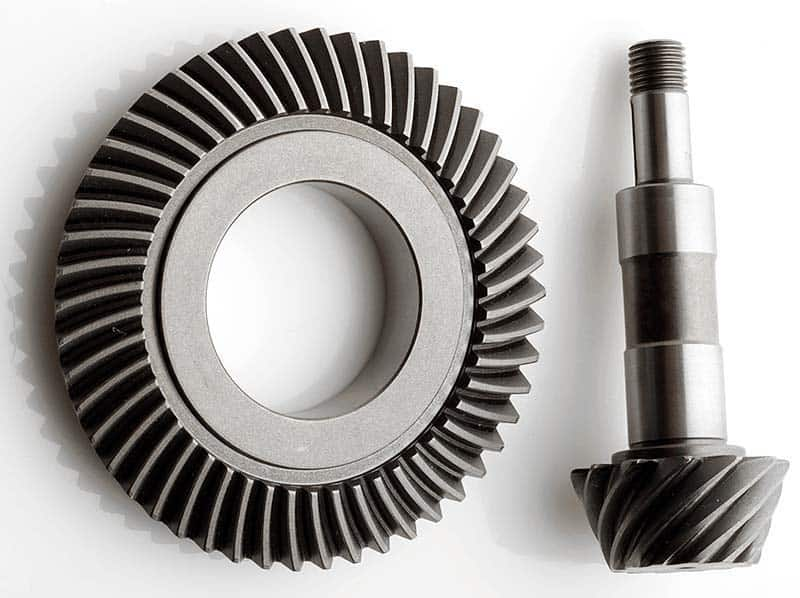
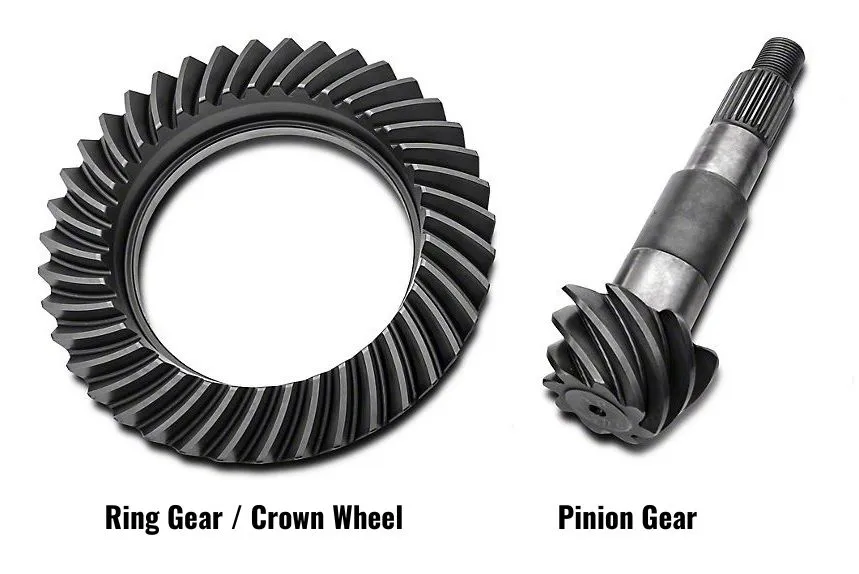
The most frequent cause of ring and pinion gear noise is incorrect setup during installation. For a gear set to run quietly, the “backlash”—the small gap between the mating teeth—must be set to within thousandths of an inch.
If the backlash is too tight, there is no room for the gear oil to form a protective film between the teeth. This leads to excessive friction, heat, and a characteristic high-pitched howl. If the backlash is too loose, the gears will “clunk” during transition from acceleration to deceleration, and the impact forces can eventually lead to tooth breakage.

Proper alignment is verified using a gear marking compound. A pattern that is too high (at the face) or too low (at the flank) concentrates all the mechanical stress on a small portion of the tooth, leading to rapid deformation and noise.

3. The Role of the Carburized Case and Surface Hardness

While installation is a major factor, the manufacturing quality of the gear itself cannot be overlooked. Ring and pinion gears are case-hardened through a process called carburizing.

The carburized case is the carbon-enriched outer shell of the gear tooth. Its job is to provide the extreme hardness required to resist the sliding friction inherent in hypoid gears.

  • If the case is too thin: The surface may lack the structural integrity to support heavy loads, leading to “sub-surface deformation” where the hard shell collapses into the softer core. This creates surface roughness and loud whining.
  • If the case is too thick, the gear tooth can become overly brittle. While it may be very quiet initially, it loses the ability to absorb shock, making it prone to snapping under sudden torque.
A high-quality gear set must have a precisely controlled case depth to balance wear resistance with structural toughness.

4. Lubrication Failure and Thermal Distress

Gear oil is the lifeblood of the differential. It doesn’t just lubricate; it carries heat away from the gear teeth and suspends contaminants.
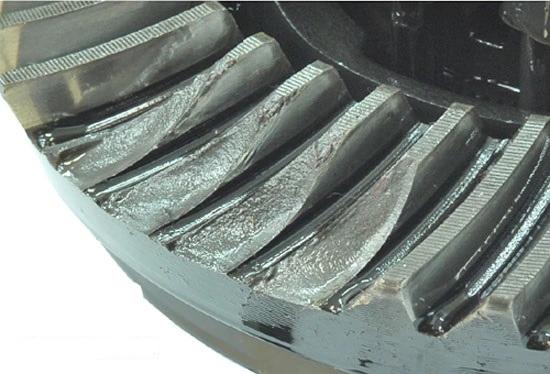
When the oil breaks down—either due to age, water contamination, or extreme heat—metal-to-metal contact occurs. This leads to a failure mode known as Scoring. Scoring creates a rough, “torn” appearance on the tooth surface. Once the smooth, polished finish of the gear is lost, the resulting ring and pinion gear noise will be permanent, as the gears can no longer slide across each other without vibration.
Furthermore, if the differential runs too hot, it can actually “re-temper” the steel, softening the hardened surface and making the gears “gummy” and prone to rapid wear.

5. Fatigue, Pitting, and Spalling

In high-mileage vehicles, noise often develops slowly over time. This is usually the result of surface fatigue.
Pitting begins as microscopic cracks on the gear face. As these cracks grow, small chunks of metal flake away—a process called spalling. This destruction of the tooth profile creates a low-frequency growl or vibration. While this can be caused by simple “old age,” it is often accelerated by using an oil with insufficient extreme-pressure (EP) additives or by consistently overloading the vehicle beyond its design capacity.
ring-and-pinion-gears-noise

6. Distinguishing Gear Noise from Bearing Noise

It is a common mistake to replace a ring and pinion set when the actual culprit is a carrier or pinion bearing.

  • Pinion Bearing Noise: Usually a high-frequency whirring sound. Since the pinion rotates several times for every one rotation of the ring gear, the sound is much faster than a ring gear “click.”
  • Carrier Bearing Noise: A lower-pitched growl that may change in intensity when the vehicle is steered side-to-side (as the load shifts from one bearing to the other).
Testing the differential on a lift and using a stethoscope to isolate the sound to the bearing hubs versus the center pumpkin is a critical diagnostic step.

Conclusion

Eliminating ring and pinion gear noise requires a combination of precision installation and high-standard manufacturing. Whether it is ensuring the perfect backlash or verifying the depth of the carburized case, every detail counts in the high-stress environment of a differential.

At XJXPARTS, we are a specialized factory committed to producing high-precision drivetrain components. Our ring and pinion sets are manufactured with strict metallurgical controls to ensure durability and silent operation. If you are looking for reliable gear sets or need a professional manufacturing partner, please contact us today for more information.
Explore More

Get a Quote Now

    Business Type*

    Order Quantity (Select from dropdown)*

    *Your privacy will be 100% safe with us. Learn more details about the Terms & Conditions and Privacy Policy on this website.*
    Open chat
    Hello, Can we help you?