Written by the Engineering Team
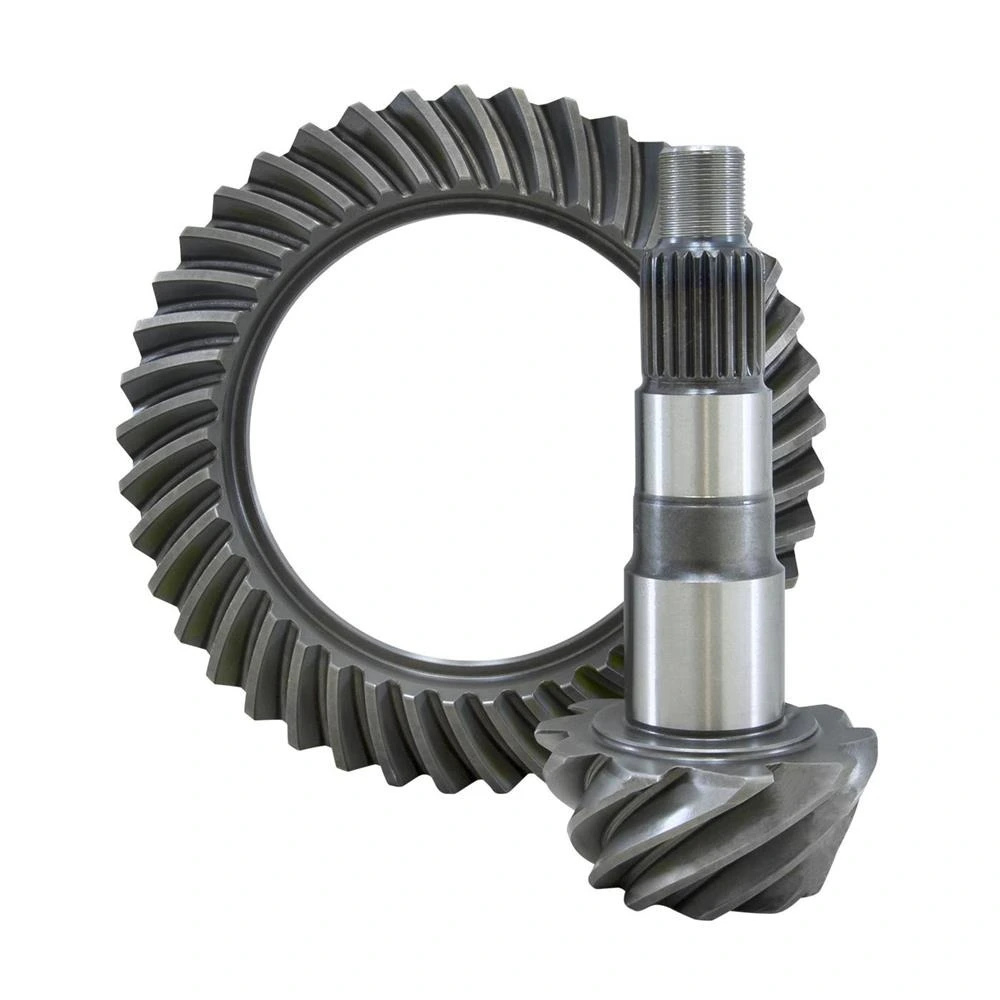
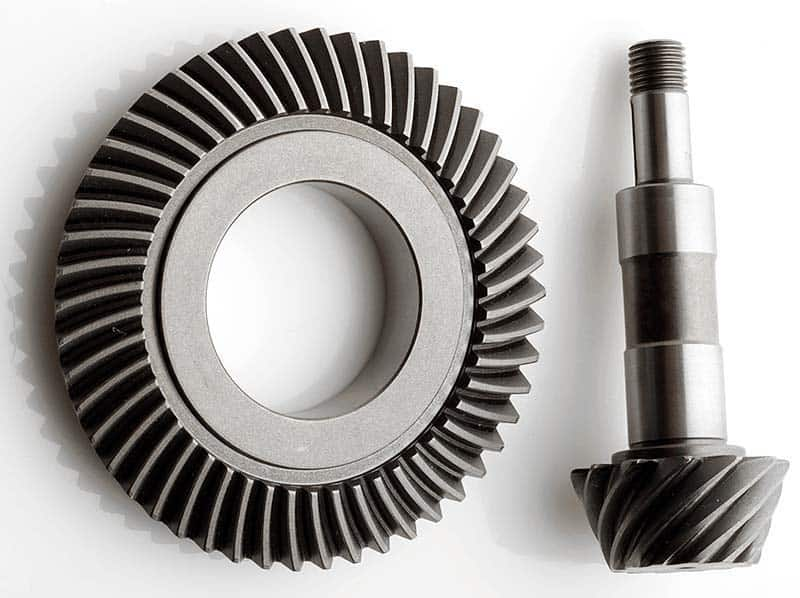
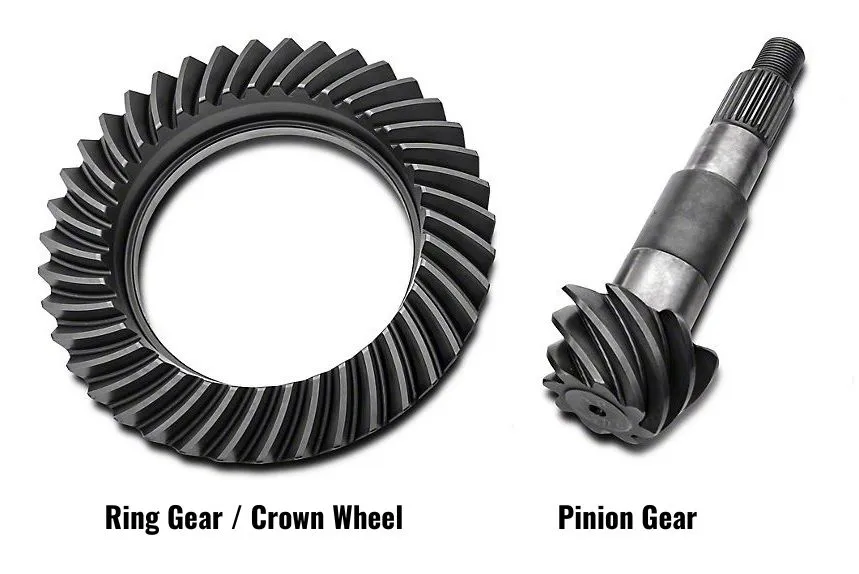
Crown wheel and pinion and ring and pinion refer to the same component. Both describe a matched bevel gear pair — a large driven gear and a smaller drive gear — used inside a differential to redirect torque and reduce rotational speed. The difference is purely regional: “crown wheel and pinion” is the standard term in the UK, Europe, Australia, and Asia; “ring and pinion” is used in North America, particularly the United States.
What Is a Crown Wheel and Pinion?
Together, they perform two mechanical functions:
- They redirect rotational force by 90 degrees — from the longitudinal axis of the driveshaft to the transverse axis of the drive axles.
- They reduce speed and multiply torque in proportion to the gear ratio (the tooth-count relationship between the two gears).
The term “crown wheel” originates from British engineering tradition, where the large gear’s face resembles a crown when viewed from above. This naming convention became standard across the UK, Europe, Australia, and most of Asia through decades of OEM documentation and trade standards.
For a full mechanical breakdown of how this gear pair functions inside a differential, see: What Is a Crown Wheel and Pinion?
What Is a Ring and Pinion?
“Ring and pinion” is the standard term in:
- US and Canadian automotive OEM documentation
- North American aftermarket and performance parts catalogs
- Off-road and 4WD communities in the US
- Agricultural equipment manufactured in North America
Why Do Two Different Terms Exist?
Both conventions became deeply embedded through:
- OEM service manuals and parts catalogs printed over decades
- Trade school and apprenticeship training programs
- Regional industry standards bodies
- Aftermarket parts suppliers operating within each market
Neither term is more technically correct than the other. The component is identical.
Crown Wheel and Pinion vs Ring and Pinion: Side-by-Side Comparison
| Factor | Crown Wheel and Pinion | Ring and Pinion |
|---|---|---|
|
Engineering definition |
Bevel gear set used in differential assemblies |
Bevel gear set used in differential assemblies |
|
Are they the same component? |
Yes — same gear pair, different regional name |
|
|
Primary region of use |
UK, Europe, Australia, Asia |
USA, Canada |
|
Origin of the term |
British engineering tradition (visual resemblance to a crown) |
American engineering tradition (geometric description) |
|
Common industries |
Automotive, heavy trucks, marine, industrial machinery |
Automotive, off-road, performance, agricultural |
|
OEM documentation |
European and Asian OEM service manuals |
American OEM documentation and parts catalogs |
|
Interchangeable terms? |
Yes — always verify specifications, not just the name |
|
What Actually Matters When Sourcing
The terminology difference has no engineering significance. What does matter when specifying or ordering these gears is:
- Gear ratio — expressed as ring gear teeth ÷ pinion teeth (e.g., 37÷10 = 3.70:1). This determines speed and torque output. See: How Crown Wheel and Pinion Gears Affect Vehicle Performance
- Tooth count — the exact number of teeth on both gears must match your differential housing.
- Tooth profile — hypoid, spiral bevel, or straight bevel. Hypoid is most common in passenger vehicles; spiral bevel in trucks and industrial equipment.
- Housing and bolt pattern — the crown/ring gear must fit your differential carrier and axle housing.
- Rotation direction — standard or reverse rotation, which affects driveshaft layout. See: Understanding Reverse and Standard Rotation Crown Gears
- Material and heat treatment — case-hardened steel grades vary by application (passenger car, heavy truck, off-road, motorsport).
When contacting a gear supplier across different regions, always lead with the gear ratio and tooth count — not just the name. A supplier in the UK and a supplier in the US may both understand your requirement, but only if the specification is clear.
Are There Any Cases Where the Terms Mean Something Different?
If your vehicle or equipment is from Europe, UK, or Asia
Documentation and suppliers will use “crown wheel and pinion.” Search using this term first when looking for parts or technical data.
If your vehicle or equipment is from North America
Documentation and suppliers will use “ring and pinion.” Use this term when contacting US-based aftermarket or OEM suppliers.
Frequently Asked Questions
Is a crown wheel and pinion the same as a ring and pinion?
What does a crown wheel and pinion do?
A crown wheel and pinion transfers engine torque from the driveshaft to the drive axles. It does this by changing the direction of rotation by 90 degrees and reducing rotational speed while increasing torque, according to the gear ratio. It is a core component of every rear-wheel, four-wheel, and all-wheel drive differential.
What is the difference between a crown wheel and a pinion?
The crown wheel is the large gear in the pair — it is driven by the smaller pinion. The pinion connects to the driveshaft and is the driving gear. The crown wheel connects to the differential carrier and drives the axles. Together they are called a crown wheel and pinion set, or ring and pinion set.
Can I use a ring and pinion from a US supplier for a European vehicle?
Potentially, yes — provided the specifications match: gear ratio, tooth count, tooth profile (hypoid, spiral bevel), and housing bolt pattern. The terminology difference is irrelevant as long as the physical specifications are compatible. Always verify specifications in detail before ordering cross-region parts.
What gear ratio should I choose for my crown wheel and pinion?
The correct gear ratio depends on your application, engine output, and performance goals. Lower ratios (e.g., 3.08:1 or 3.31:1) favor fuel efficiency and highway cruising. Higher ratios (e.g., 4.10:1 or 4.56:1) improve low-speed torque, towing capacity, and off-road traction. For a full breakdown, see our article on how crown wheel and pinion ratios affect vehicle performance.
What causes crown wheel and pinion noise?
Common causes include incorrect backlash, improper pinion preload, worn or pitted gear teeth, insufficient or degraded gear oil, and incorrect gear contact pattern during installation. A howling sound under load often indicates backlash or preload issues; a clunking sound may indicate worn teeth or bearing failure.
Can crown wheel and pinion gears be custom manufactured?
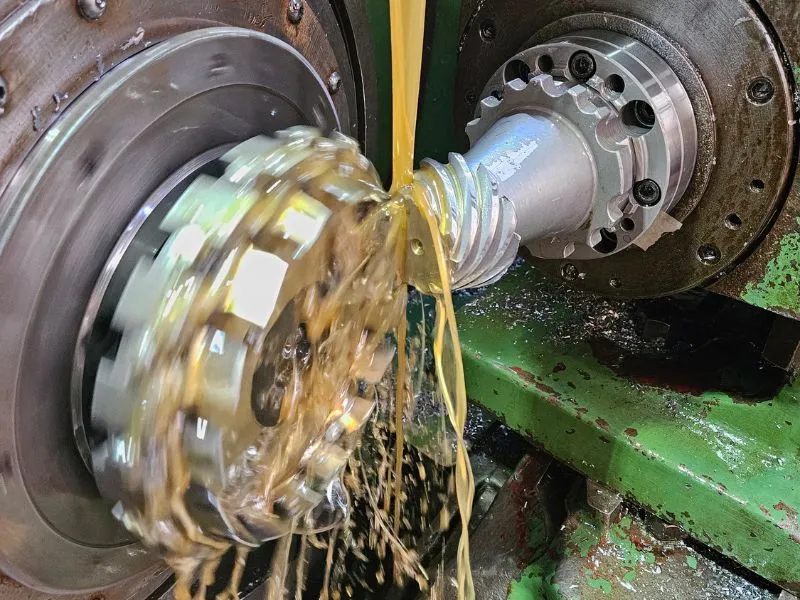
Yes. Custom crown wheel and pinion sets can be manufactured to specific gear ratios, tooth profiles, materials, and surface treatments. This is common in motorsport, heavy equipment, agricultural machinery, and marine applications where standard OEM ratios are unsuitable. As a factory manufacturer, we produce custom sets to customer specifications.
How long do crown wheel and pinion gears last?
With correct installation, proper lubrication, and normal operating conditions, crown wheel and pinion gears typically last the lifetime of the vehicle or equipment — often 150,000 miles or more. Premature wear is usually caused by incorrect backlash adjustment, contaminated gear oil, overloading, or incorrect installation preload.
What is the difference between hypoid and spiral bevel crown wheel and pinion gears?
Hypoid gears have offset axes — the pinion centerline sits below the centerline of the ring/crown gear. This allows a lower driveshaft height, more teeth in contact simultaneously, and quieter operation. Spiral bevel gears have intersecting axes with no offset. Hypoid is the standard in passenger cars and light trucks; spiral bevel is common in heavy trucks, agricultural equipment, and some industrial drives.
What is the pinion depth in a crown wheel and pinion setup?
Pinion depth refers to how deep the pinion sits in the differential housing relative to the crown wheel. Correct pinion depth is critical for achieving the proper gear contact pattern and preventing premature wear or noise. It is measured during installation using a depth gauge and shim adjustment, and verified by checking the contact pattern under load.